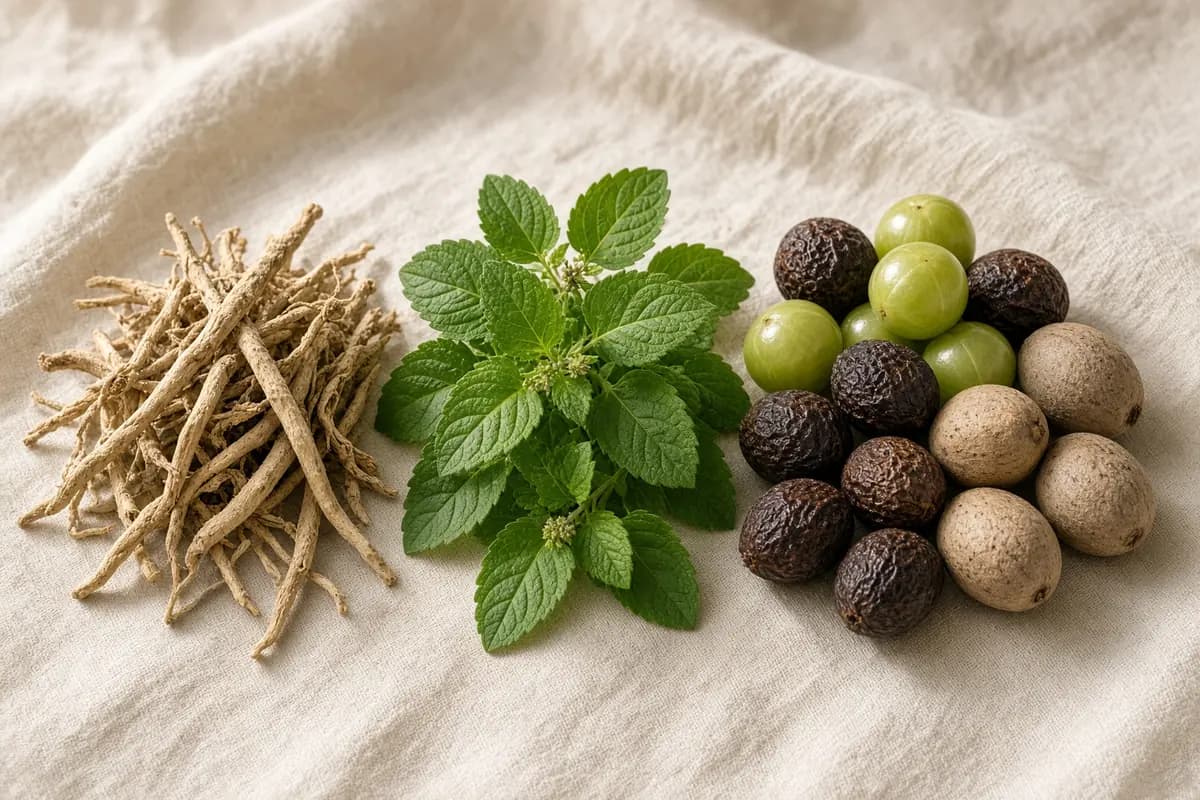
Ashwagandha, tulsi and triphala: a sensible guide to three famous herbs
Three of Ayurveda's most popular herbs — what they are traditionally used for, how they are taken, and the precautions everyone should know.
Published 4 August 2026 · 4 min read
Walk into any Indian pharmacy or health store today and you will find shelves full of ashwagandha capsules, tulsi drops and triphala tablets. These three herbs have become famous around the world. But popularity can hide an important truth: herbs are active substances, and using them wisely matters.
This guide explains how each herb is viewed in Ayurveda, how it is traditionally taken, and — just as importantly — who should be careful.
Ashwagandha (Withania somnifera)
What it is. Ashwagandha is a small shrub whose root has been used in Ayurveda for thousands of years. The name is often explained as "the smell of a horse", referring both to the root's earthy smell and to the strength it was believed to give.
Traditional use. Ashwagandha is classified as a rasayana — a rejuvenating herb — and is considered an adaptogen, something that helps the body cope with stress. It has traditionally been used to support strength and stamina, recovery after illness, a calm mind and restful sleep. In Ayurvedic terms it is warming and grounding, and particularly pacifies vata.
How it is taken. Classically, the root powder is simmered in warm milk, sometimes with ghee and a little jaggery, and taken in the evening. Today it is also sold as tablets, capsules and extracts, which vary widely in strength.
Be careful if you:
- Are pregnant or breastfeeding — avoid it.
- Have a thyroid condition, an autoimmune disease, or liver problems.
- Take sedatives, sleeping pills, anti-anxiety medicine, thyroid medicine, blood pressure or diabetes medicine.
- Are scheduled for surgery.
Rare cases of liver injury have been reported with ashwagandha supplements, so buy from reputable, tested brands and stop immediately if you notice yellowing of the eyes or skin, dark urine or abdominal pain.
Tulsi (Holy basil, Ocimum sanctum)
What it is. Tulsi is the sacred basil grown in the courtyards of countless Indian homes. It is revered in Hindu tradition and has been part of daily life for centuries.
Traditional use. Ayurveda regards tulsi as warming, light and aromatic, particularly useful for balancing kapha and vata. It is traditionally used during coughs and colds, to support respiratory comfort and immunity, and as a gentle aid for everyday stress. A few fresh leaves in tea or a kadha is the most common way to enjoy it.
How it is taken. Chew two or three washed fresh leaves in the morning, add a few leaves to tea, or simmer them with ginger and black pepper as a kadha. Dried tulsi tea is also widely available.
Be careful if you:
- Are pregnant, trying to conceive, or breastfeeding — use only food amounts and check with your doctor.
- Take blood-thinning medicine or are about to have surgery.
- Take diabetes medicine, as tulsi may lower blood sugar.
A small, traditional note: it is customary to swallow tulsi leaves quickly or steep them rather than chewing for a long time, as the leaves contain compounds that may not be kind to tooth enamel.
Triphala
What it is. Triphala means "three fruits". It is a blend of equal parts of dried amalaki (amla), bibhitaki and haritaki. Each fruit is considered to balance one of the doshas, which is why triphala is described as tridoshic — suitable for all constitutions.
Traditional use. Triphala is one of the most commonly used formulas in Ayurveda. It is best known as a gentle support for regular bowel movements and digestive health. It is also traditionally used as an eyewash (in carefully prepared forms under a practitioner's guidance) and as a mild rasayana.
How it is taken. Most commonly, half a teaspoon of powder is stirred into warm water and taken at bedtime. Tablets are an option for those who dislike the strong, astringent taste.
Be careful if you:
- Are pregnant or breastfeeding — avoid it.
- Have diarrhoea, or a very sensitive stomach.
- Take diabetes medicine or blood thinners.
- Want to give it to children — only on a practitioner's advice.
Five rules for using any herb
- Talk to your doctor first, especially if you take regular medicine, have a chronic condition, or are pregnant.
- Buy quality. Choose products from reputable manufacturers with batch numbers, expiry dates and, ideally, testing for heavy metals and contaminants. Be very careful with unlabelled powders.
- Start low. Begin with the smallest amount and observe how you feel.
- Take breaks. Ayurveda generally recommends herbs for a defined period, not indefinitely, unless supervised.
- Distrust miracle claims. No herb cures cancer, diabetes or heart disease. Any product claiming to do so is not trustworthy.
The bigger picture
In Ayurveda, herbs are never the whole story. They work best on a foundation of good food, regular routine, restful sleep and a calm mind. If you are interested in using herbs regularly, a consultation with a qualified Ayurvedic practitioner (BAMS) is the safest way to choose the right herb, form and amount for you.
Related remedies
 Giloy (guduchi): how it's used, a simple kadha and who should avoid itGiloy, the heart-leaved climber called guduchi or amrita in Ayurveda, became a household name during the pandemic. Traditionally it's used for recurring fevers, low immunity and digestion. Here's how to use it sensibly in a mild decoction, and why it isn't for everyone.
 Moringa (sahjan): cooking the leaves, pods and flowers for everyday nutritionThe drumstick tree growing in so many Indian backyards is a nutrition powerhouse. Its leaves are rich in iron, calcium, vitamin A and protein, and its pods are a favourite in sambar. The best way to benefit is simply to cook it as food, regularly.
 Neem: the village pharmacy for skin, scalp and home hygieneNeem has been called the ‘village pharmacy’ of India. Its bitter leaves are mostly used externally — in bath water, face packs, hair rinses and as a natural insect deterrent — and occasionally in food, such as neem-flower dishes during Ugadi.
Related recipes
Get a weekly dose of Ayurveda
One seasonal tip, one remedy and one simple habit — every week, in English or Hindi. No spam, unsubscribe any time.