- toe raises exercise
- shin strengthening
- ankle mobility
- fall prevention exercise
Wall-Supported Toe Raises for Front-Ankle Strength
A gentle exercise lifting the forefoot while heels stay down, with balance and nerve precautions.
Important: this remedy is only a supportive home measure. Keep taking any medicine your doctor has prescribed, monitor your readings, and consult your doctor before adding anything new.
toe raises exercise: method, benefits and precautions
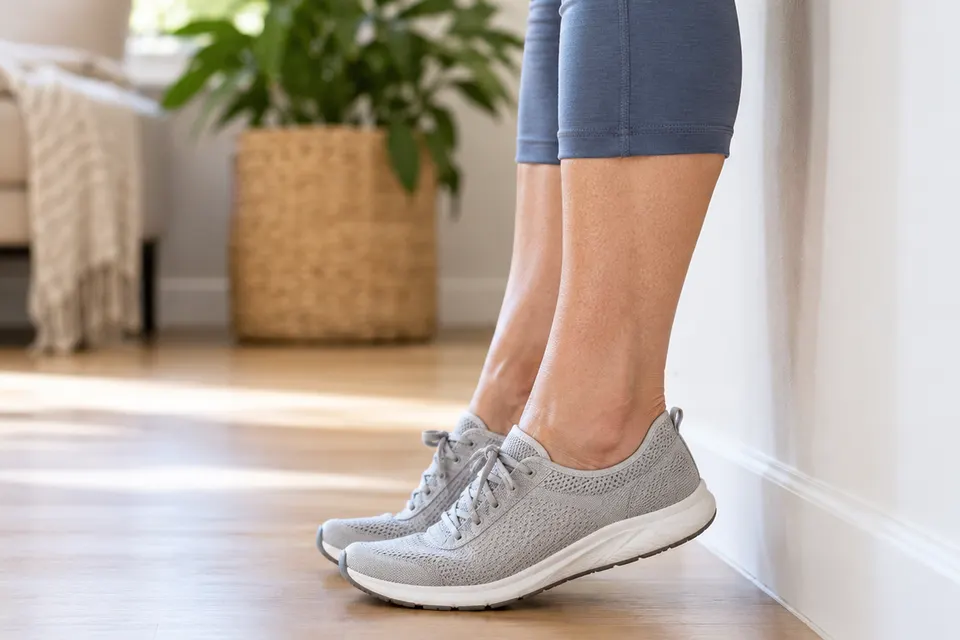
Toe raises are different from heel raises: the heels remain down while the front of the feet lifts a little. The useful goal is a smooth, comfortable ankle movement, not the largest possible angle. A wall nearby does not remove the need for a secure support and a floor with good grip.
Position yourself where a fixed counter or other suitable support is easy to hold. Keep your heels planted and gently lift the toes and forefoot, then lower them quietly. Use a small range if that is all you can control. Keep breathing normally and avoid leaning so far backwards that you depend on the wall to catch you.
Check that footwear does not slip or catch. Stop if the movement causes pain, cramp or instability rather than forcing the ankle farther. There is no need to combine it with a heel raise or add resistance in the same session. If standing is difficult, seek a suitable alternative rather than improvising a risky setup.
This practice does not diagnose foot drop, nerve problems or the cause of a trip. New trouble lifting a foot, repeated unexplained falls, or altered sensation needs professional assessment. People with an existing injury or reduced foot sensation should get individual advice before adopting a new standing routine.
Ingredients
- Stable wall or counter
- Flat supportive shoes
- Clear floor
How to prepare
- Stand with heels planted.
- Lift toes and forefeet gently.
- Lower slowly for five to ten repetitions.
How to use
- Lift the forefoot gently with heels down and stable support. Stop before discomfort or loss of balance.
Helpful habits
- Keep heels on the floor.
- Choose control over range.
- Do not use a wall as a fall-catching device.
Precautions
- New foot drop, numbness, severe back pain or repeated tripping needs medical assessment.
- Ask a clinician first if you have allergies, are pregnant, have a long-term condition or take regular medicines.
- Seek urgent care for severe pain, breathing difficulty, fainting, repeated vomiting, bleeding or rapidly worsening symptoms.
Frequently asked questions
Is this a calf raise?
- No; calf raises lift the heels, whereas this lifts the forefoot.
Can it treat new foot weakness?
- New weakness needs assessment, not self-treatment.
Prepared by: All Ayurvedics editorial team
No clinician review is recorded for this page. This is general information, not individual diagnosis or treatment advice.
Responsible site owner/editor: Manoj Singh. Editorial responsibility